
PMP Exam Simulation
EVOLVE Trainer Materials
230:00

PMP Exam Simulation – 180 Questions
Clean one-question-per-page HTML exam with corrected option formatting, improved exhibits, answer review, and EVOLVE branding.
Question List
Select a question number to navigate directly.
123456789101112131415161718192021222324252627282930313233343536373839404142434445464748495051525354555657585960616263646566676869707172737475767778798081828384858687888990919293949596979899100101102103104105106107108109110111112113114115116117118119120121122123124125126127128129130131132133134135136137138139140141142143144145146147148149150151152153154155156157158159160161162163164165166167168169170171172173174175176177178179180
Question 1
PMBOK® 8th-oriented project management emphasizes principles that guide decisions rather than only following fixed processes. Match each principle shown in the exhibit with the primary decision focus it supports.
Exhibit
Question 2
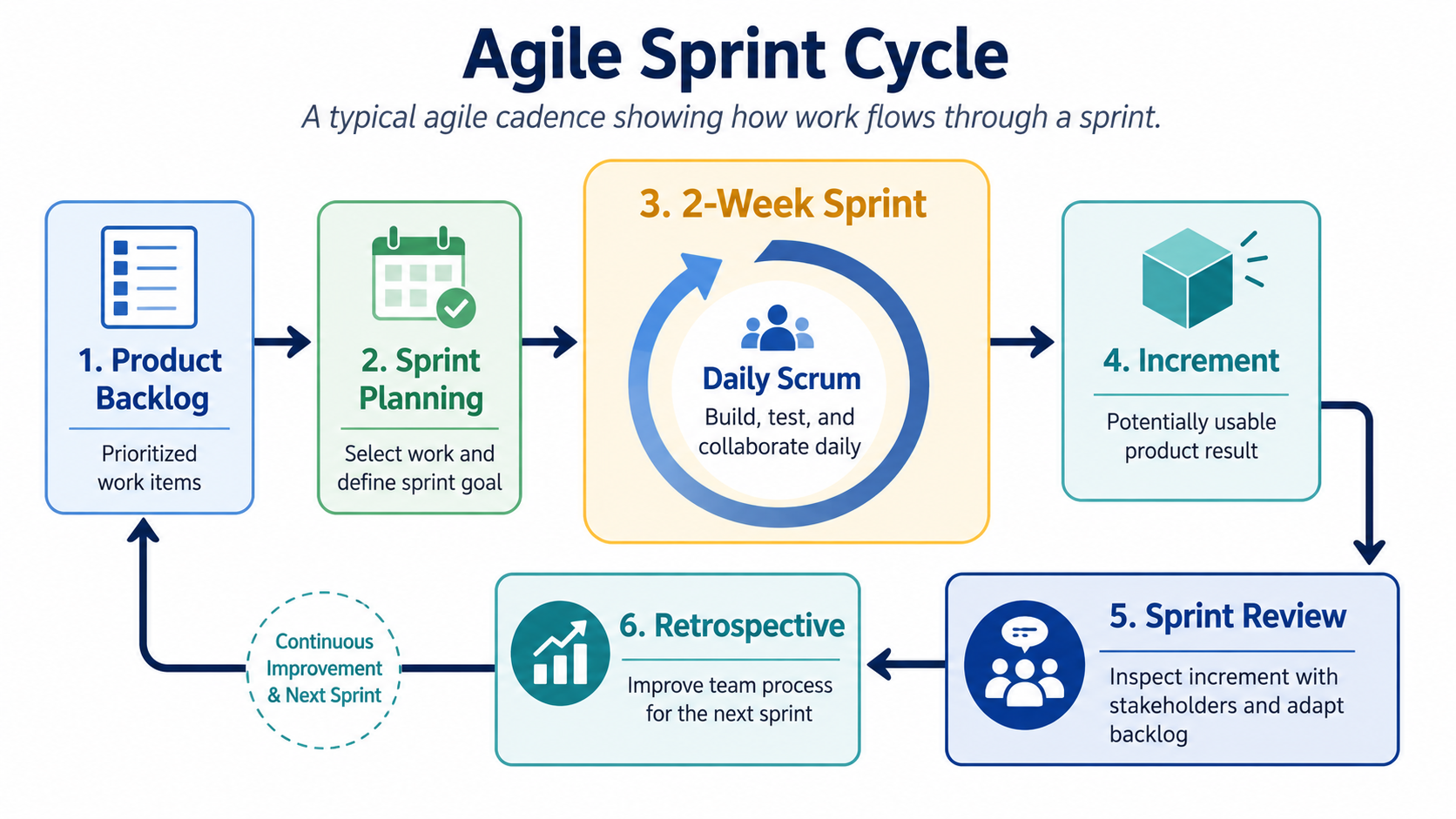
The exhibit shows a typical agile sprint cycle. A project manager wants to identify the event where the team and stakeholders inspect the increment and use the findings to adapt the product backlog for upcoming work. Which event should the project manager focus on?
Exhibit
Question 3
Use the development approach matrix in the exhibit. Match each project situation with the most appropriate development approach.
Exhibit
Question 4
The exhibit shows a governance tailoring continuum. Match each project environment with the most appropriate governance response.
Exhibit
Question 5
The exhibit shows several project performance domains interacting with project work. Match each domain with the best focus area.
Exhibit
Question 6
The project manager is reviewing the performance trend shown in the exhibit. The organization requires corrective action when either CPI or SPI falls below 0.90.
What is the best interpretation of the project’s current performance?
Exhibit
Question 7
A project team is in the executing phase of a predictive project. The project manager discovers that the actual cost is exceeding the planned budget due to rework caused by quality defects. The defects were not caught early because the team skipped quality reviews to save time.
Which principle was violated, and what is the primary lesson?
Which principle was violated, and what is the primary lesson?
Question 8
A project manager is leading a compliance-heavy project in a bank. The project requires documented approvals, clear escalation paths, regulatory reporting, and formal sign-offs before key releases. A team member suggests using informal team decisions to move faster.
What should the project manager do?
What should the project manager do?
Question 9
A project manager is facilitating an early planning workshop for a new strategic initiative. During the discussion, several issues emerge:
The original business case assumptions are no longer valid.
The team cannot begin work because it does not yet have authority to use resources.
Stakeholders have different interpretations of the project purpose and cannot see how objectives, risks, deliverables, and roles connect.
The organization may not have enough internal capability, so outsourcing could be considered.
Match each situation with the best project manager response.
What is the correct matching sequence?
The original business case assumptions are no longer valid.
The team cannot begin work because it does not yet have authority to use resources.
Stakeholders have different interpretations of the project purpose and cannot see how objectives, risks, deliverables, and roles connect.
The organization may not have enough internal capability, so outsourcing could be considered.
Match each situation with the best project manager response.
What is the correct matching sequence?
Exhibit
| Situation | Best Response |
|---|---|
| 1. Business case assumptions are no longer valid | A. Review project justification and expected benefits |
| 2. Team lacks authority to use resources | B. Obtain formal project authorization |
| 3. Stakeholders cannot see the big picture | C. Use a visual planning tool to align objectives, risks, deliverables, and roles |
| 4. Internal capability is weak and outsourcing may be needed | D. Perform make-or-buy and sourcing analysis |
Question 10
A project manager is developing the schedule network for a new compliance reporting system. The project starts on Day 0. The activities, durations, and dependencies are shown below.
The compliance manager asks whether Activity C can be delayed by 2 days because the reporting specialist is needed on another urgent project.
Based on the schedule network, what should the project manager say?
The compliance manager asks whether Activity C can be delayed by 2 days because the reporting specialist is needed on another urgent project.
Based on the schedule network, what should the project manager say?
Exhibit
| Activity | Duration | Predecessor |
|---|---|---|
| A. Define reporting requirements | 4 days | None |
| B. Design data model | 6 days | A |
| C. Configure reporting tool | 5 days | A |
| D. Build data interfaces | 7 days | B |
| E. Develop report templates | 6 days | B and C |
| F. Perform system testing | 4 days | D and E |
| G. Obtain compliance approval | 3 days | F |
Question 11
GlobalPath Consulting is a large project management consultancy that delivers projects across multiple countries, regions, and time zones. Since many of its projects are similar, senior management is concerned that valuable project knowledge may be lost after projects are completed.
What should GlobalPath Consulting do to help ensure project knowledge is retained and reused across the organization?
What should GlobalPath Consulting do to help ensure project knowledge is retained and reused across the organization?
Question 12
A project manager wants to show accountable leadership during a difficult project recovery effort. The project has missed two milestones, the customer is frustrated, and team morale is low.
Which actions best demonstrate accountable leadership? Select THREE.
Which actions best demonstrate accountable leadership? Select THREE.
Question 13
A project manager is reviewing the project’s earned value performance trend. At Month 5, the project data is:
PV = $700,000
EV = $560,000
AC = $680,000
Based on the graph, what is the best interpretation of the project’s performance?
PV = $700,000
EV = $560,000
AC = $680,000
Based on the graph, what is the best interpretation of the project’s performance?
Exhibit
Question 14
A project manager is developing the schedule for a website redesign project. The project starts on Day 0. The team identifies the following activities:
Which statement is correct?
Which statement is correct?
Exhibit
| Activity | Duration | Dependency |
|---|---|---|
| A. Complete UX design | 6 days | Starts at project start |
| B. Develop front-end pages | 8 days | Starts 2 days after A starts |
| C. Prepare user documentation | 5 days | Starts 3 days before B finishes |
| D. Conduct final review | 4 days | Starts after both B and C are finished |
| E. Launch approval milestone | 0 days | Occurs after D is finished |
Question 15
An organization in the UK is forming an agile development team for an upcoming mobile app project. The team will use an incremental delivery approach to release usable features over time.
Which of the following are NOT desirable characteristics for this agile team? Select THREE.
Which of the following are NOT desirable characteristics for this agile team? Select THREE.
Question 16
A project manager is leading a sustainability-related facilities project. The sponsor wants the cheapest materials to reduce initial cost. The operations manager warns that the cheaper materials will increase maintenance cost and energy use for years. The community relations manager is concerned about environmental impact.
What should the project manager do?
What should the project manager do?
Question 17
A project manager is leading a project to replace a legacy purchasing system. The sponsor is focused on launching the new system quickly because the current tool is expensive to maintain. During planning, the project manager discovers that procurement, finance, and operations each have different expectations about approval workflows. The team wants to continue with the technical design because the deadline is tight.
What should the project manager do next?
What should the project manager do next?
Question 18
A project manager is leading a project to implement a new internal knowledge platform. The project is intended to reduce repeated mistakes, improve onboarding, and make lessons learned easier to reuse. The technical build is progressing well. However, users say the platform is difficult to search, department leads disagree on ownership of content, and no one has defined how the platform’s benefits will be measured.
Which actions best support value delivery? Select TWO.
Which actions best support value delivery? Select TWO.
Question 19
A project manager is evaluating two options for adding a new fraud-detection feature to a banking system. The sponsor wants the option with the better expected financial outcome, considering both implementation cost and uncertain benefits.
Which option has the better Expected Monetary Value (EMV)?
Which option has the better Expected Monetary Value (EMV)?
Exhibit
| Option | Implementation Cost | Outcome | Probability | Financial Benefit |
|---|---|---|---|---|
| Option A: Build internally | $120,000 | High adoption | 60% | $350,000 |
| Option A: Build internally | $120,000 | Low adoption | 40% | $100,000 |
| Option B: Buy vendor solution | $180,000 | High adoption | 70% | $420,000 |
| Option B: Buy vendor solution | $180,000 | Low adoption | 30% | $150,000 |
Question 20
A project manager is leading a project in a highly regulated industry. The team wants to use agile practices because requirements are evolving. The product owner wants frequent demonstrations, while the regulatory affairs manager requires evidence of approvals, traceability, and controlled decision-making. Some team members argue that “agile means we should not document too much.”
What should the project manager do?
What should the project manager do?
Question 21
A project team is developing a customer-facing mobile application. The team is moving quickly, but the project manager notices that lessons from the previous mobile project are not being used. Several issues that occurred last year are starting to appear again. Team members say they are too busy to look at old project records.
What should the project manager do?
What should the project manager do?
Question 22
A project manager is leading a customer-facing AI chatbot project. The team completed the chatbot on time and within budget. During final testing, the project manager discovers that the chatbot gives misleading answers in some cases involving customer refunds. The sponsor says the issue affects only a small percentage of customers and asks the project manager to report the project as successful so the launch date is not missed.
What should the project manager do?
What should the project manager do?
Question 23
A project team has autonomy to prioritize work within a product increment. However, two subteams make conflicting decisions about the same customer workflow. Each team says it is self-governing and does not need approval.
What should the project manager do?
What should the project manager do?
Question 24
A project manager is offered an assignment to lead a highly specialized cybersecurity compliance project. The project manager has general project management experience but limited cybersecurity knowledge. The sponsor says, “You are good at managing people. You can learn the technical parts later.” The project has high regulatory exposure and could affect customer data protection.
What should the project manager do?
What should the project manager do?
Question 25
A project manager is assigned to a project that will replace a manual customer onboarding process with a digital platform. The organization has a standard predictive methodology with formal approvals at the end of each phase. However, the product team explains that many customer-facing requirements are unclear and will need to be refined through feedback from pilot users. The compliance department requires strict documentation for identity verification features, while the marketing team wants early releases to test adoption. The project sponsor asks the project manager to “just follow the standard methodology so the project remains controlled.”
What should the project manager do?
What should the project manager do?
Question 26
A project manager is managing a project in a balanced matrix organization. A scope disagreement has escalated between two departments, and the project manager cannot resolve it at the project level. The disagreement affects funding priorities and a key milestone. The sponsor has authority to clarify priorities and resolve conflicts beyond the project manager’s control.
What should the project manager do?
What should the project manager do?
Question 27
A distributed agile team is experiencing poor collaboration. Team members are in different time zones, several are part-time, and specialists work in functional silos. Work is frequently handed off between departments, and defects are discovered late.
Which actions should the project manager take? Select THREE.
Which actions should the project manager take? Select THREE.
Question 28
A project manager is leading a public-sector technology project. The team can meet the launch date by removing accessibility features, but doing so would reduce use by citizens with disabilities. The sponsor says the launch date is politically important and asks the project manager to “handle accessibility later.”
Which actions should the project manager take? Select TWO.
Which actions should the project manager take? Select TWO.
Question 29
A project manager is leading a team that recently moved to agile. The team holds daily standups, but each meeting lasts 45 minutes and becomes a problem-solving session. Blockers are discussed but not resolved, and team members report the same impediments repeatedly. The sponsor says agile is wasting time.
What should the project manager do?
What should the project manager do?
Question 30
A team is estimating the duration of a data migration activity. The estimates are:
Optimistic: 12 days
Most likely: 18 days
Pessimistic: 36 days
The sponsor asks, “How much uncertainty is in this estimate?” The project manager wants to explain the approximate one-standard-deviation range.
What should the project manager report?
Optimistic: 12 days
Most likely: 18 days
Pessimistic: 36 days
The sponsor asks, “How much uncertainty is in this estimate?” The project manager wants to explain the approximate one-standard-deviation range.
What should the project manager report?
Question 31
An agile team has been underutilized for the last four iterations while building a single-page application using React JS. The team has six members with React development skills, but the product backlog items selected for each iteration are only enough to fully utilize four team members.
Which agile meeting is most likely not being performed effectively, resulting in too few ready backlog items for the team to select?
Which agile meeting is most likely not being performed effectively, resulting in too few ready backlog items for the team to select?
Question 32
A project manager is reviewing the schedule network for a product launch. The team has identified three possible paths:
A senior stakeholder asks whether the team can delay activity E by two days to allow a specialist to support another urgent issue.
What should the project manager say?
A senior stakeholder asks whether the team can delay activity E by two days to allow a specialist to support another urgent issue.
What should the project manager say?
Exhibit
| Path | Activities | Duration |
|---|---|---|
| Path 1 | A → B → D → G | 18 days |
| Path 2 | A → C → E → G | 22 days |
| Path 3 | A → C → F → G | 20 days |
Question 33
A large program includes multiple projects delivered by different organizations. One vendor uses a predictive approach, the internal digital team uses agile, and a third-party compliance group requires formal reviews. The project manager notices inconsistent definitions of “done,” unclear handoff criteria, and conflicting change-control expectations.
What should the project manager do?
What should the project manager do?
Question 34
A project manager is reviewing several schedule-related situations. Match each situation with the best interpretation or action.
What is the correct matching sequence?
What is the correct matching sequence?
Exhibit
| Situation | Best Response |
|---|---|
| 1. Activity H has ES = 10, LS = 14, and the team wants to delay it by 3 days. | A. Use PERT expected duration because it considers uncertainty. |
| 2. Activity E is on the longest path in the network and a stakeholder wants to delay it. | B. Accept the delay because the activity has 4 days of total float, but monitor the remaining flexibility. |
| 3. A noncritical path is delayed and may become longer than the original critical path. | C. Do not delay without analysis because it is on the critical path. |
| 4. The sponsor wants to use only the optimistic estimate for a task with uncertainty. | D. Recalculate the schedule because the critical path can change. |
Question 35
A team’s first three iterations produced working increments, but stakeholders rejected much of the work during demos because acceptance criteria were vague. Developers say they built what they understood, testers say they could not test properly, and the product owner says the team should have asked more questions before development.
What should the project manager or team facilitator do?
What should the project manager or team facilitator do?
Question 36
A project manager is managing a system upgrade. The original schedule has the following paths:
The original critical path is A → B → D → H. During execution, Activity E on the second path is delayed by 5 days. The sponsor says, “Since E is not on the critical path, this delay cannot affect the project.”
What should the project manager do?
The original critical path is A → B → D → H. During execution, Activity E on the second path is delayed by 5 days. The sponsor says, “Since E is not on the critical path, this delay cannot affect the project.”
What should the project manager do?
Exhibit
| Path | Duration |
|---|---|
| A → B → D → H | 30 days |
| A → C → E → H | 27 days |
| A → C → F → H | 25 days |
Question 37
A project manager is leading a project across three countries. The team faces different labor regulations, data privacy laws, cultural expectations, and time-zone constraints. The sponsor asks the project manager to “standardize everything” and use the same communication and approval process in all locations.
What should the project manager do?
What should the project manager do?
Question 38
Because the backend developers sent the API in an improper format, the frontend code is no longer working correctly. This has created tension and conflict between the backend and frontend developers, and the situation is now negatively affecting overall project delivery.
As the project manager, you want to reduce the tension and help resolve the conflict between the team members.
Which of the following skills are you most likely to use?
As the project manager, you want to reduce the tension and help resolve the conflict between the team members.
Which of the following skills are you most likely to use?
Question 39
A project manager is reviewing a Cost Plus Incentive Fee (CPIF) contract for a specialized data center installation. The contract includes the following terms:
The project was completed below the target cost. According to the contract, cost savings are shared between the buyer and seller using the agreed share ratio.
What is the total amount paid to the seller?
The project was completed below the target cost. According to the contract, cost savings are shared between the buyer and seller using the agreed share ratio.
What is the total amount paid to the seller?
Exhibit
| Contract Element | Value |
|---|---|
| Target Cost | $500,000 |
| Target Fee | $50,000 |
| Buyer/Seller Share Ratio | 80/20 |
| Actual Cost | $450,000 |
Question 40
A project manager is leading a customer service improvement project. During a product review, the customer rejects the Reporting Dashboard because two operational KPIs that were discussed informally during a workshop are not included. The team confirms that the dashboard meets the approved scope baseline and the documented acceptance criteria.
At the same time, a senior stakeholder asks the team to start building the AI recommendation engine, saying it will increase business value and “should be included because the project is already improving customer service.”
Based on the exhibit, what should the project manager do next?
At the same time, a senior stakeholder asks the team to start building the AI recommendation engine, saying it will increase business value and “should be included because the project is already improving customer service.”
Based on the exhibit, what should the project manager do next?
Exhibit
| WBS ID | Work Package / Deliverable | Status | Acceptance Criteria | Customer Validation | Change Request Status |
|---|---|---|---|---|---|
| 1.1 | Requirements workshops | Completed | Stakeholder needs documented and approved | Accepted | N/A |
| 1.2 | Process redesign | Completed | Future-state workflow approved by operations | Accepted | N/A |
| 1.3 | Reporting dashboard | Completed | Displays approved operational KPIs | Rejected | CR-014 submitted |
| 1.4 | Mobile access feature | In progress | Secure access for approved user groups | Not yet validated | N/A |
| 1.5 | AI recommendation engine | Not in baseline scope | No approved acceptance criteria | Not validated | No approved CR |
Question 41
A project manager is supporting an agile team during a 10-day iteration. The team committed to completing 100 story points. At the end of the iteration, the burndown chart shows that a large amount of work is still remaining.
What should the project manager or team facilitator do first?
What should the project manager or team facilitator do first?
Exhibit
Question 42
A project manager is assigned to a smart city infrastructure project. The project charter has been approved, initial stakeholders identified, and a high-level budget committed. The PM is now working to clarify stakeholder influence, define the initial scope, and assign key project management roles.
Which focus area is the project manager primarily engaged in?
Which focus area is the project manager primarily engaged in?
Question 43
A project team is developing a new internal workflow system. During the review meeting, the team proudly reports that they completed more work than planned for the period. The sponsor wants to approve a team bonus and asks the project manager to confirm that the project is performing well.
The current data is:
BAC: $900,000
PV: $450,000
EV: $480,000
AC: $600,000
What should the project manager say?
The current data is:
BAC: $900,000
PV: $450,000
EV: $480,000
AC: $600,000
What should the project manager say?
Question 44
A key executive who was previously highly engaged in a project has missed the last three monthly steering committee meetings. While project reports are being delivered via the automated dashboard, no feedback has been received. What is the most effective next step to monitor communications?
Question 45
A project has a budget at completion of $1,200,000. The sponsor asks whether the project can still finish within the approved budget. The project manager reviews the current performance:
PV: $600,000
EV: $500,000
AC: $625,000
The team believes the cost overrun is not a one-time issue because productivity problems and vendor rework are expected to continue.
What should the project manager recommend?
PV: $600,000
EV: $500,000
AC: $625,000
The team believes the cost overrun is not a one-time issue because productivity problems and vendor rework are expected to continue.
What should the project manager recommend?
Question 46
Refer to the "Impact of Variables over Time" showing Risk & Uncertainty decreasing over time while Cost of Changes increases over time.
At which project phase does the "Optimal Influence Point" occur?
At which project phase does the "Optimal Influence Point" occur?
Exhibit
Question 47
Tina is managing a new mobile app project that is very similar to a recently completed app project within her organization. The new app is less strategically significant than the previous one, and Tina expects limited resource availability. The PMO has also maintained useful organizational knowledge and artifacts from the previous project, including risk registers, issue logs, and lessons learned.
Given this project context, which risk management activity could Tina most reasonably skip with the least impact on the project objectives?
Given this project context, which risk management activity could Tina most reasonably skip with the least impact on the project objectives?
Question 48
An agile team is working on a software module. During the Sprint Review, the Product Owner rejects a completed story because it does not meet the organization’s new accessibility standards, even though the story met the specific "Acceptance Criteria" written in the backlog. How should the team prevent this in the future?
Question 49
A project manager is estimating the cost of a small software enhancement. The team decomposes the work and provides the following estimates:
The risk register identifies several known risks, and the team recommends a 10% contingency reserve. The sponsor asks for the cost baseline for the work, including contingency.
What should the project manager report?
The risk register identifies several known risks, and the team recommends a 10% contingency reserve. The sponsor asks for the cost baseline for the work, including contingency.
What should the project manager report?
Exhibit
| Work Package | Estimated Cost |
|---|---|
| Requirements analysis | $8,000 |
| Design | $12,000 |
| Development | $40,000 |
| Testing | $18,000 |
| Deployment support | $7,000 |
Question 50
A project team has just completed the project management plan and is now coordinating resources, managing stakeholder engagement, and performing the work to produce deliverables. The development approach is most visible during this phase.
Which focus area describes these activities?
Which focus area describes these activities?
Question 51
A project manager is leading a cross-functional project with 8 team members. The sponsor asks the project manager to add 2 additional subject matter experts because the work is becoming more complex. The project manager agrees that the expertise may help, but wants to explain that adding people will also increase communication complexity.
What should the project manager communicate?
What should the project manager communicate?
Question 52
A pharmaceutical company is launching a new drug to treat a rare disease. The project has a fixed regulatory deadline, requires extensive clinical trials, and must comply with strict FDA guidelines. The scope is well-defined, but the company wants to incorporate patient feedback during the trial phases to refine the drug's delivery mechanism.
Based on this scenario, what is the most appropriate development approach?
Based on this scenario, what is the most appropriate development approach?
Question 53
A project manager is deciding whether to implement an additional security control for a new online payment system. If the control is implemented, it will cost $80,000, but it will reduce the probability of a major security incident. If no control is implemented, the project saves the $80,000 but faces higher risk.
The risk analysis shows:
What should the project manager recommend from an expected monetary value perspective?
The risk analysis shows:
What should the project manager recommend from an expected monetary value perspective?
Exhibit
| Decision | Risk Event | Probability | Impact if Risk Occurs |
|---|---|---|---|
| Implement control | Security incident | 10% | -$500,000 |
| Do not implement control | Security incident | 35% | -$500,000 |
Question 54
A project manager is reviewing the schedule network diagram for a project. The activity durations are shown in the diagram.
Activity C is followed by Activity G. However, Activity G cannot start until both predecessor paths leading into it are complete.
Based on the network diagram, what is the free float for Activity C?
Activity C is followed by Activity G. However, Activity G cannot start until both predecessor paths leading into it are complete.
Based on the network diagram, what is the free float for Activity C?
Exhibit
Question 55
Your project team has identified several risks and assessed their probability and impact. You are reviewing the risk response strategies for each risk.
Based on the risk response matrix shown, which identified risk should most appropriately use the Transfer strategy?
Based on the risk response matrix shown, which identified risk should most appropriately use the Transfer strategy?
Exhibit
Question 56
The project team has completed the implementation of a cybersecurity system according to the client’s requirements. However, even after the new system is in place, there is still a possibility of a security breach due to human error or remaining system vulnerabilities.
This is an example of which type of risk?
This is an example of which type of risk?
Question 57
Using the project status boxes located on the right side, drag each box to the correct point on the performance chart where the project indicates that status. Each box must correspond to a specific reporting period on the chart.
Exhibit: Project Performance Over Time
Drag-and-Drop Status Boxes
Ahead of schedule and under budget
Ahead of schedule but over budget
Behind schedule and over budget
Behind schedule but under budget
Exhibit: Project Performance Over Time
Drag-and-Drop Status Boxes
Ahead of schedule and under budget
Ahead of schedule but over budget
Behind schedule and over budget
Behind schedule but under budget
Exhibit
| Reporting Period | CPI | SPI |
|---|---|---|
| Month 1 | 1.05 | 1.02 |
| Month 2 | 0.96 | 1.04 |
| Month 3 | 0.89 | 0.92 |
| Month 4 | 1.03 | 0.88 |
Exhibit
Question 58
A project manager is working in different project environments. Match each situation with the most appropriate project manager response.
What is the correct matching sequence?
What is the correct matching sequence?
Exhibit
| Situation | Best Response |
|---|---|
| 1. A bank project requires formal approvals, regulatory reporting, and documented sign-offs. | A. Use agile feedback loops while tailoring documentation and governance to meet compliance needs. |
| 2. An adaptive product team can reprioritize work but the organization still needs visibility and early warning signs. | B. Use a structured decision and approval process suitable for the regulatory risk. |
| 3. A regulated project wants agile practices, but the regulatory manager requires traceability and controlled decision-making. | C. Use lightweight governance with objectives, decision boundaries, progress indicators, and feedback loops. |
| 4. Two agile subteams make conflicting decisions and claim self-governance means no approval is needed. | D. Establish shared objectives, decision boundaries, and alignment mechanisms. |
Question 59
A project manager is negotiating a 36-month contract for specialized construction materials. The scope is stable, so the buyer prefers a fixed-price structure. However, both parties are concerned about inflation in raw material prices over the long contract duration. The contract includes an economic price adjustment clause.
The base contract value is $5,000,000. The agreed economic adjustment is based on a 5% CPI increase.
What should the project manager expect the adjusted contract value to be?
The base contract value is $5,000,000. The agreed economic adjustment is based on a 5% CPI increase.
What should the project manager expect the adjusted contract value to be?
Question 60
BrightPath Solutions expects frequent changes during a new project, so leadership has decided to use an adaptive approach. The project will include a business analyst and a project team working together daily. As the project manager, you want to apply adaptive planning.
Which statement best describes adaptive planning?
Which statement best describes adaptive planning?
Question 61
A large-scale project involves a partnership between a government agency and two private contractors, each with different risk tolerances and reporting standards. What is the first step the Project Manager should take to ensure alignment?
Question 62
A project manager is trying to protect project value and organizational learning. Match each situation with the best response.
What is the correct matching sequence?
What is the correct matching sequence?
Exhibit
| Situation | Best Response |
|---|---|
| 1. Users say the new workflow does not support urgent claims, although the team is on schedule. | A. Define benefit measures and clarify ownership for maintaining content after launch. |
| 2. A project has no clear benefits measurement approach, but the sponsor says benefits are “obvious.” | B. Use existing lessons learned and create new knowledge during the project. |
| 3. A knowledge platform is being built, but benefits measurement and content ownership are unclear. | C. Review the concerns against the business case, expected benefits, and value delivery. |
| 4. The team is repeating mistakes from a previous project because lessons learned are not being used. | D. Clarify expected benefits, benefit measures, ownership, and timing before finalizing the plan. |
Question 63
The total cost estimate for all project work packages is $800,000. The Project Manager identifies $80,000 in contingency reserves for known risks. The organization also sets aside $40,000 as a management reserve for "unknown unknowns." What is the Cost Baseline for this project?
Question 64
A project team is tailoring its approach for a new mobile application. The product requirements are evolving, the market is changing quickly, customers are available for frequent feedback, and the organization wants value delivered every month. However, the team is new to agile, and several members are only assigned part-time.
Which actions should the project manager take? Select THREE.
Which actions should the project manager take? Select THREE.
Question 65
An organization is evaluating two projects. Project Alpha has an NPV (Net Present Value) of $250,000 and a payback period of 3 years. Project Beta has an NPV of $300,000 and a payback period of 4 years. Based on financial theory, which project should the organization select?
Question 66
A project manager is managing a regulatory system upgrade. The current schedule duration is 28 days, but the sponsor says the project must be completed in 25 days to meet a compliance deadline.
The current critical path is:
A → B → D → G
The project manager identifies the following crashing options:
The current path durations are:
What is the least-cost crashing option to meet the 25-day deadline?
The current critical path is:
A → B → D → G
The project manager identifies the following crashing options:
The current path durations are:
What is the least-cost crashing option to meet the 25-day deadline?
Exhibit
| Activity | On Path | Maximum Crash | Crash Cost per Day |
|---|---|---|---|
| B | Critical Path | 2 days | $4,000/day |
| D | Critical Path | 3 days | $6,000/day |
| E | Non-critical Path | 2 days | $3,000/day |
| F | Non-critical Path | 1 day | $2,000/day |
Exhibit
| Path | Activities | Duration |
|---|---|---|
| Path 1 | A → B → D → G | 28 days |
| Path 2 | A → C → E → G | 25 days |
| Path 3 | A → C → F → G | 24 days |
Question 67
A Project Manager has completed a qualitative risk analysis and wants to perform a quantitative analysis to determine the probability of finishing the project by a specific date. Which tool should be used to provide a distribution of possible outcomes?
Question 68
A project team completed the main deliverable, and the sponsor wants to close immediately. However, the project manager notices that several lessons learned have not been captured, project documents are not archived, operational handover is incomplete, and release of resources has not been coordinated.
What should the project manager do?
What should the project manager do?
Question 69
A project requires 3 senior engineers for 6 weeks at 80% utilization. Each engineer is available 40 hours per week. However, one engineer has a pre-approved absence for 2 full weeks. What is the total available resource capacity for this project?
Question 70
A project manager is helping a team choose between predictive, iterative, incremental, and agile life cycles. The product is complex, customers do not fully understand what they need, and the team expects to refine the solution through repeated feedback. However, the final product will be released once after the solution is correct.
Which life cycle is most appropriate?
Which life cycle is most appropriate?
Question 71
A program involves three organizations: a government client, a prime contractor, and two subcontractors. Each organization follows different project management methodologies and reporting standards. Which approach BEST supports alignment across organizations?
Question 72
A project manager is leading the construction of a new regional data center. During risk planning, the team identifies several negative risks/threats:
Which set of threat response strategies is most appropriate?
Which set of threat response strategies is most appropriate?
Exhibit
| Threat | Situation |
|---|---|
| Threat 1 | The selected site is located in a flood-prone area. The team can choose a different approved site, but it will require an early design adjustment. |
| Threat 2 | There is a risk that equipment delivery may be delayed because of customs inspection. The team can order critical equipment earlier and add buffer time to the logistics plan. |
| Threat 3 | Specialized cooling equipment may fail during the warranty period. The project can purchase an extended warranty and maintenance contract from the supplier. |
| Threat 4 | Minor weather delays may occur during outdoor installation. The impact is small, and the team decides to monitor the situation without taking active action now. |
| Threat 5 | A new national cybersecurity regulation may require major design changes. This decision is beyond the project manager’s authority and must be handled by executive leadership. |
Question 73
A project has a budget at completion (BAC) of $500,000. The risk register identifies $40,000 in contingency reserves for known risks. The management reserve is set at 10% of BAC. A new unknown risk materializes, costing $35,000. Which reserve should be used, and what approval is required?
Question 74
A project manager is managing a project where requirements are changing, stakeholder expectations are evolving, and new risks are emerging. The sponsor wants confidence that the project is still under control without creating excessive bureaucracy.
Which actions should the project manager take? Select THREE.
Which actions should the project manager take? Select THREE.
Question 75
A project manager is procuring specialized cybersecurity services. The scope is not fully defined, and the vendor’s costs are difficult to estimate upfront. However, the organization needs to incentivize the vendor to control costs. Which contract type is MOST appropriate?
Question 76
A team is delivering a new internal analytics tool. They release small usable features every three weeks, but requirements are not changing much. Business stakeholders mainly want faster delivery of known capabilities, not continuous redesign. The project manager wants to choose the most appropriate delivery approach without overcomplicating the process.
Which approach best fits?
Which approach best fits?
Question 77
A project manager calculates the EMV of a major risk event as -$50,000. However, the team is concerned that if this risk occurs, it could trigger a chain of secondary risks that may fundamentally threaten the project’s viability. Which risk analysis technique should supplement EMV to capture this complexity?
Question 78
A project manager is leading a renewable-energy project to install solar panels across several government buildings. During risk planning, the team identifies several positive risks/opportunities:
Which set of opportunity response strategies is most appropriate?
Which set of opportunity response strategies is most appropriate?
Exhibit
| Opportunity | Situation |
|---|---|
| Opportunity 1 | A new government grant may fully fund the battery-storage component if the project submits the application within two weeks. |
| Opportunity 2 | A new panel supplier may improve energy output by 15%, but the team needs to adjust the design to increase the chance of gaining that benefit. |
| Opportunity 3 | A technology partner has specialized expertise in energy analytics and is willing to co-develop the monitoring dashboard in exchange for shared benefits. |
| Opportunity 4 | There is a small chance that energy prices will rise, which would increase the financial value of the project, but no practical action is needed. |
Question 79
A project manager is reviewing the project schedule network diagram below. Each activity duration is shown in days.
The project cannot be completed until all required paths leading to Activity H are finished.
What is the shortest possible time to complete the project, and which path is the critical path?
The project cannot be completed until all required paths leading to Activity H are finished.
What is the shortest possible time to complete the project, and which path is the critical path?
Exhibit
Question 80
During a requirements workshop, a senior stakeholder dominates the discussion and several users remain silent. The project manager is concerned that the final solution will reflect only one person’s view.
What should the project manager do?
What should the project manager do?
Question 81
A team has adopted Scrum, but stakeholders complain that the team is “busy” while no one can see real progress. The project manager reviews reports and finds that the team reports tasks as 80–90% complete for several weeks. There is no reliable evidence of working features, and the backlog is not regularly refined. The product owner is frequently unavailable.
What should the project manager do first?
What should the project manager do first?
Question 82
A healthcare organization is running several initiatives at the same time. One initiative is building a new patient mobile app. Another initiative is upgrading the hospital billing system. A third initiative is improving call-center response time through process changes. These initiatives are grouped together because they all support the organization’s strategic objective of improving patient experience. Separately, the hospital continues its daily activities, such as admitting patients, processing insurance claims, and scheduling appointments.
Which statement best describes this situation?
Which statement best describes this situation?
Question 83
A project manager is leading a data migration project for a bank. During planning, the team identified a high-priority risk that customer records may fail validation during migration. The approved risk response was to run a pilot migration, assign a data-quality owner, and prepare automated validation scripts before the full migration weekend.
Two weeks before migration, the project manager discovers that the pilot migration has not been performed, the validation scripts are incomplete, and the data-quality owner has been reassigned to another project. The risk has not occurred yet, but the probability is increasing.
What should the project manager do next?
Two weeks before migration, the project manager discovers that the pilot migration has not been performed, the validation scripts are incomplete, and the data-quality owner has been reassigned to another project. The risk has not occurred yet, but the probability is increasing.
What should the project manager do next?
Question 84
A project manager uses a checklist from a previous project to prepare for a major deployment. The checklist includes communication, testing, rollback, and approval steps. A team member says, “If it is on the checklist, we are safe.”
What should the project manager do?
What should the project manager do?
Question 85
A PMO provides a standard methodology for all projects. A project manager is assigned to a low-risk internal workflow automation project with five team members, no regulatory impact, and a six-week delivery window. The standard methodology requires a large steering committee, multiple approval gates, and extensive documentation. The sponsor is frustrated because the process may take longer than the work itself.
What should the project manager do?
What should the project manager do?
Question 86
A project manager is reviewing how different types of work are organized in a large organization. The organization has daily customer support activities, a temporary project to implement a new CRM system, a group of related digital transformation projects coordinated together to improve customer experience, and a collection of projects and programs selected to achieve the organization’s strategic goals.
Match each concept with the correct description.
What is the correct matching sequence?
Match each concept with the correct description.
What is the correct matching sequence?
Exhibit
| Concept | Description |
|---|---|
| 1. Project | A. Ongoing, repetitive work that sustains the business |
| 2. Program | B. A temporary effort that creates a unique product, service, or result |
| 3. Portfolio | C. Related projects managed together to achieve benefits not available from managing them separately |
| 4. Operations | D. Projects, programs, and other work grouped to achieve strategic objectives |
Question 87
A project manager is developing the schedule for a data migration project. The approved schedule baseline shows that the project must finish in 30 days. The critical path is:
A → B → D → F
Another path is:
A → C → E → F
The current schedule shows the following:
The problem is that B and C are scheduled at the same time, and both require the same Senior Data Engineer. Only one Senior Data Engineer is available. The sponsor says the project deadline should not change unless there is no other realistic option.
What should the project manager do first?
A → B → D → F
Another path is:
A → C → E → F
The current schedule shows the following:
The problem is that B and C are scheduled at the same time, and both require the same Senior Data Engineer. Only one Senior Data Engineer is available. The sponsor says the project deadline should not change unless there is no other realistic option.
What should the project manager do first?
Exhibit
| Activity | Duration | Total Float | Resource Needed |
|---|---|---|---|
| A | 4 days | 0 days | Data Architect |
| B | 8 days | 0 days | Senior Data Engineer |
| C | 6 days | 4 days | Senior Data Engineer |
| D | 10 days | 0 days | Senior Data Engineer |
| E | 5 days | 4 days | Senior Data Engineer |
| F | 3 days | 0 days | Data Architect |
Question 88
A project manager is facilitating a status meeting. The team spends most of the meeting discussing unrelated technical details. No decisions are made, actions are not assigned, and the same issues return every week.
What should the project manager do?
What should the project manager do?
Question 89
Review the exhibit.
What is the best integrated response?
What is the best integrated response?
Exhibit
| Problem | Current Response | Result |
|---|---|---|
| Defects found late | More final testing | Schedule pressure increases |
| Changing priorities | Larger status reports | Stakeholders still dissatisfied |
| Blocked stories | Team starts more work | WIP increases |
| Product owner unavailable | Team guesses priorities | Rework increases |
Question 90
A project manager is integrating several planning components for a new enterprise resource planning implementation. The scope team has created a WBS, the schedule team has developed a timeline, the procurement lead has prepared a sourcing approach, and the risk lead has identified major vendor and data-migration risks. During review, the project manager discovers that the schedule assumes vendor resources will start in two weeks, while the procurement plan shows vendor selection will take six weeks. The cost baseline also does not include the additional testing effort required by the quality plan.
Which actions should the project manager take to integrate and align the project plans? Select THREE.
Which actions should the project manager take to integrate and align the project plans? Select THREE.
Question 91
A team is preparing to start a project that will introduce a new supplier portal. The business case is approved, but the project manager notices several assumptions: the vendor API will be available in two months, procurement approval will take less than four weeks, and business users will be available for testing during peak season.
Which actions should the project manager take? Select TWO.
Which actions should the project manager take? Select TWO.
Question 92
A project manager is leading a core banking system upgrade. The team is preparing the responsibility assignment matrix for the “User Acceptance Testing Sign-off” deliverable. During planning, the following situation occurs:
The Testing Lead will coordinate test execution and collect defect results.
The Business Operations Manager must confirm that the system supports real business workflows.
The Compliance Officer must review whether regulatory requirements are satisfied before approval.
The Project Sponsor wants to be updated but does not want to participate in detailed testing decisions.
The Project Manager will track progress and remove blockers but should not personally approve the business acceptance of the system.
The team wants to avoid confusion about who does the work, who gives input, who receives updates, and who has final ownership of the deliverable.
Which RACI assignment is most appropriate for the User Acceptance Testing Sign-off deliverable?
The Testing Lead will coordinate test execution and collect defect results.
The Business Operations Manager must confirm that the system supports real business workflows.
The Compliance Officer must review whether regulatory requirements are satisfied before approval.
The Project Sponsor wants to be updated but does not want to participate in detailed testing decisions.
The Project Manager will track progress and remove blockers but should not personally approve the business acceptance of the system.
The team wants to avoid confusion about who does the work, who gives input, who receives updates, and who has final ownership of the deliverable.
Which RACI assignment is most appropriate for the User Acceptance Testing Sign-off deliverable?
Question 93
A project is in execution. A major stakeholder requests a change that would improve user satisfaction but would also increase cost and delay a regulatory milestone. The sponsor asks the project manager to approve it immediately because the stakeholder is influential.
What should the project manager do?
What should the project manager do?
Question 94
A project manager is assessing whether to empower an agile team to make more local decisions. The team is experienced, cross-functional, stable, and has strong collaboration practices. However, the project has high security risk and external compliance obligations.
Which actions are most appropriate? Select TWO.
Which actions are most appropriate? Select TWO.
Question 95
A project manager is leading the execution of a new online payment platform. The project management plan has been approved, and the team has started building the deliverables. During execution, the project manager notices that the development team is waiting for security requirements, the testing team is blocked by unavailable test data, and two team leads are working from different versions of the scope baseline.
What should the project manager do next?
What should the project manager do next?
Question 96
A project is under pressure to start quickly. The sponsor wants the project manager to begin assigning people and spending funds immediately. The project manager has been named informally, but there is no formal authorization document linking the project to the business case, confirming organizational commitment, or granting authority to use resources.
What should the project manager request?
What should the project manager request?
Question 97
A project manager is planning a software implementation project. Several tasks involve the business analyst, development lead, testing lead, and sponsor. During planning, the team becomes confused because different people believe they have final decision authority for the same deliverable. The project manager wants to clarify who performs the work, who makes the final decision, who provides input, and who should be kept informed.
Which tool should the project manager use?
Which tool should the project manager use?
Question 98
Review the change impact exhibit.
What is the best project manager response?
What is the best project manager response?
Exhibit
| Change Benefit | Change Impact |
|---|---|
| Higher user satisfaction | +6 weeks schedule delay |
| Better usability | Additional supplier cost |
| Stronger adoption potential | Regulatory milestone risk |
| Stakeholder support | Requires training redesign |
Question 99
An agile team is working at a sustainable pace, but a senior manager repeatedly interrupts team members with urgent requests from outside the backlog. Velocity becomes unpredictable, planned work is not completed, and morale drops. The manager argues that agility means responding to every change immediately.
What should the project manager do?
What should the project manager do?
Question 100
A project manager is planning a new hospital information system. The team has collected the major deliverables: patient registration, billing, appointment scheduling, reporting, and user training. Several team members want to start estimating activities immediately, but the project manager says the deliverables first need to be broken down into smaller, more manageable components.
What should the project manager do next?
What should the project manager do next?
Question 101
A project manager is preparing a facilitated workshop with selected operations managers, users, and subject matter experts to understand expectations for a new service model. The goal is not to interview people individually but to encourage discussion, compare viewpoints, and surface concerns.
Which techniques are most appropriate? Select TWO.
Which techniques are most appropriate? Select TWO.
Question 102
A project manager is leading a public transportation modernization project. During stakeholder analysis, the project manager identifies the following stakeholders:
The project manager needs to decide how to prioritize stakeholder engagement and communication.
Which approach is most appropriate?
The project manager needs to decide how to prioritize stakeholder engagement and communication.
Which approach is most appropriate?
Exhibit
| Stakeholder | Power | Interest | Urgency | Legitimacy |
|---|---|---|---|---|
| City mayor | High | Medium | Medium | High |
| Daily commuters | Low | High | High | High |
| Regulatory authority | High | Low | High | High |
| Local media | Medium | High | Medium | Low |
Question 103
A project manager is assigned to a project in a weak matrix organization. Functional managers control the team members’ assignments, and the project manager has limited authority. A critical resource is repeatedly pulled into operational work, causing project delays. The project manager is frustrated and wants to directly reassign the person full time to the project.
What should the project manager do?
What should the project manager do?
Question 104
During a phase-gate review, the customer refuses to accept a deliverable, claiming it lacks a specific feature. The Project Manager checks the WBS Dictionary and the Scope Statement, confirming the feature is not listed. However, the customer points to a transcript from a mid-sprint stakeholder meeting where the feature was discussed. What should the Project Manager have done differently?
Question 105
A project team is developing a new online claims system. During testing, users complain that an important requirement for urgent claims handling was missed. The business analyst says the requirement was mentioned in an early workshop, but no one can show whether it was documented, approved, designed, built, or tested.
What should the project manager have ensured earlier? Select TWO.
What should the project manager have ensured earlier? Select TWO.
Question 106
A project manager discovers that several planning assumptions have changed. The best project document to update is the [ Select ].
Question 107
A project manager is leading a software implementation project. The testing lead and development lead disagree about the root cause of repeated defects. The testing lead says the development team is rushing code, while the development lead says the test cases are unclear. The conflict is affecting team trust, and the issue must be solved because the same defects may continue in future releases.
What should the project manager do?
What should the project manager do?
Question 108
A project team is using an AI tool to forecast schedule delays and recommend resource allocations. The tool’s recommendations appear useful, but the project manager learns that the data set may contain incomplete historical records from similar projects. The sponsor wants the team to rely on the tool because it creates impressive dashboards.
What should the project manager do?
What should the project manager do?
Question 109
A project team is working in a highly regulated industry. They decide to use an Iterative lifecycle for development but must retain a formal, Predictive Change Control Board (CCB) to meet legal compliance. This is an example of which tailoring action?
Question 110
A project manager is planning a complex product development project. The first three months of work are well understood, so the team can define detailed activities, estimates, and assignments. However, the later phases depend on customer feedback, regulatory review results, and technical discoveries that are not yet available.
What should the project manager do?
What should the project manager do?
Question 111
A sponsor asks the project manager why planning is still changing after the charter was approved. The project manager explains that new information is becoming available, assumptions are being validated, and stakeholder needs are becoming clearer.
Which concept best supports the project manager’s explanation?
Which concept best supports the project manager’s explanation?
Question 112
During a project meeting, two senior engineers strongly disagree about the technical design for a safety-critical component. One engineer wants to use the original design because it is faster. The other engineer says the original design may create a compliance risk and recommends a more robust approach. The team is waiting for a decision, and choosing incorrectly could lead to regulatory failure.
What is the best conflict management approach?
What is the best conflict management approach?
Question 113
An organization must choose between two projects. Project A has a higher ROI but creates reputational risk and low stakeholder support. Project B has a lower financial return but supports regulatory compliance, customer trust, and a long-term strategic capability. A senior manager says the project with the highest ROI should always be selected.
What should the portfolio team do?
What should the portfolio team do?
Question 114
A team is struggling with "sprint fatigue" because their work consists of a high volume of small, unpredictable maintenance requests that often take priority over planned stories. Which approach would be most beneficial?
Question 115
A project manager is leading a hospital system upgrade. The resource management plan shows that two database specialists are assigned full-time during testing. During execution, the project manager discovers the following:
What should the project manager do next?
What should the project manager do next?
Exhibit
| Resource Issue | Current Situation |
|---|---|
| Database specialists | Over-allocated across two projects |
| Testing team | Waiting for database support |
| Training team | Scheduled to start next week, but training materials are not ready |
| External consultant | Completed assigned work and is no longer needed |
| Operations team | Needs handover support before go-live |
Question 116
Review the exhibit.
The team is repeatedly debating symptoms of a recurring production defect and cannot agree on the underlying cause.
Which technique is most appropriate?
The team is repeatedly debating symptoms of a recurring production defect and cannot agree on the underlying cause.
Which technique is most appropriate?
Exhibit
| Tool | Best Use |
|---|---|
| Focus group | Explore expectations and attitudes through moderated discussion |
| Brainwriting | Generate ideas individually before discussion |
| Five Whys | Explore possible root causes |
| SWOT | Analyze strengths, weaknesses, opportunities, and threats |
| Project canvas | Visualize key project elements on one page |
Question 117
A project manager is leading a high-performing technical team. Recently, team motivation has dropped. The team members say their salaries are fair, the office environment is acceptable, and company policies are clear. However, they feel the work is repetitive, their achievements are not recognized, and they have little opportunity to grow or take ownership.
What should the project manager focus on to improve motivation?
What should the project manager focus on to improve motivation?
Question 118
A project is behind schedule because of unresolved technical defects. The project manager prepares a status report stating, “Development is complete,” but omits that testing has failed and the deliverable cannot be released. The statement is technically true because coding is complete, but stakeholders may believe the project is ready for launch.
What should the project manager do?
What should the project manager do?
Question 119
A project manager wants to adopt a fully agile delivery method, but the organization’s PMO mandates the use of a predictive methodology with mandatory stage gates. The project manager believes agile would deliver better results. What is the MOST appropriate action?
Question 120
A project manager is leading the implementation of a new procurement system. During stakeholder analysis, the project manager prepares the following stakeholder engagement assessment matrix:
The project is entering the planning phase, and the project manager wants to improve stakeholder engagement before execution begins.
What should the project manager do next?
The project is entering the planning phase, and the project manager wants to improve stakeholder engagement before execution begins.
What should the project manager do next?
Exhibit
| Stakeholder | Current Engagement | Desired Engagement |
|---|---|---|
| Procurement director | Supportive | Leading |
| Finance manager | Neutral | Supportive |
| End users | Resistant | Supportive |
| IT security lead | Unaware | Neutral |
Question 121
A project manager is preparing a sourcing recommendation for a data migration tool. The internal team can build the tool, but it would delay the project by two months. An external vendor can provide the tool faster but introduces licensing cost, cybersecurity review, and supplier dependency.
What should the project manager do?
What should the project manager do?
Question 122
A project manager is leading an agile team developing a new customer portal. The team understands the product vision but is blocked by slow approvals, unclear access permissions, and conflicts with another department. The team members are capable and motivated, but they need organizational support to continue delivering value.
What leadership style should the project manager primarily use?
What leadership style should the project manager primarily use?
Question 123
During project execution, a new use case has emerged. Both the business team and the development team are unsure whether this additional use case should be included in the project requirements.
Because of this uncertainty, the team is becoming frustrated, and morale is starting to decline.
Which of the following should the project manager use to help the team make an appropriate decision about whether to include or exclude the new use case?
Because of this uncertainty, the team is becoming frustrated, and morale is starting to decline.
Which of the following should the project manager use to help the team make an appropriate decision about whether to include or exclude the new use case?
Question 124
An agile team’s velocity has averaged 42 story points per sprint over the last 4 sprints. The remaining backlog contains 210 story points. There are known scope additions expected to add approximately 30 story points. Approximately how many sprints will it take to complete the project?
Question 125
A project manager is leading a newly formed project team. At first, team members are polite but unsure about their roles. After a few weeks, disagreements begin about priorities, decision authority, and how work should be performed. Some team members challenge each other during meetings, and productivity temporarily drops.
What should the project manager recognize, and what should they do?
What should the project manager recognize, and what should they do?
Question 126
A project manager is defining supplier selection criteria for an outsourced component. Which factors should be considered? Select THREE.
Question 127
A project manager is leading a cross-functional project. The finance representative has become quiet in meetings and rarely provides input. The project manager notices that the finance representative looks uncomfortable when technical team members challenge budget assumptions aggressively. The project manager wants to keep the discussion honest while improving collaboration.
What should the project manager do?
What should the project manager do?
Question 128
Using the risk response boxes located on the right side, drag each box to the correct project situation. Each box must correspond to the best risk response strategy.
Drag-and-Drop Response Boxes
Exhibit: Project Risk Situations
A. Avoid
B. Mitigate
C. Transfer
D. Accept
Drag-and-Drop Response Boxes
Exhibit: Project Risk Situations
A. Avoid
B. Mitigate
C. Transfer
D. Accept
Exhibit
| Situation | Description |
|---|---|
| 1 | A supplier may delay delivery of a critical component. The team decides to order the component earlier and add schedule buffer. |
| 2 | A project site is located in a flood-prone area. The sponsor approves moving the project to a different approved location. |
| 3 | A specialized machine may fail during installation. The team purchases an extended warranty and support contract. |
| 4 | Minor weather delays may occur, but the impact is small. The team decides to monitor the risk without taking immediate action. |
Question 129
During the last three sprints, the development team has repeatedly committed code to the repository without writing clear and appropriate commit comments. The technical architect has raised concerns because the same issue continues to happen sprint after sprint.
As the project manager or Scrum Master, what should the team do to address this issue?
As the project manager or Scrum Master, what should the team do to address this issue?
Question 130
A project manager is leading two groups within the same project. The cybersecurity team is highly experienced and needs little guidance. The newly assigned data-migration team is unfamiliar with the organization’s tools and needs step-by-step direction at first. The project manager wants to lead both groups effectively.
What should the project manager do?
What should the project manager do?
Question 131
A project manager is part of a vendor selection committee for a new data analytics platform. One bidder is owned by the project manager’s close relative. The project manager believes the vendor is qualified and says nothing because the evaluation criteria are objective. During the final decision meeting, the project manager is asked to score all vendors.
What should the project manager do first?
What should the project manager do first?
Question 132
A project manager is leading a high-priority customer data migration project in a matrix organization. The project schedule depends on a senior database specialist who is also assigned to two other projects. The functional manager says the specialist can support the project only 25% of the time, but the approved schedule assumes 75% availability for the next four weeks. The project manager does not have direct authority over the specialist.
What should the project manager do?
What should the project manager do?
Question 133
During a project execution review, the project manager notices that the team has been delivering outputs that were not included in the WBS but were requested informally by a key stakeholder. The sponsor now wants these deliverables accepted as part of the formal project scope. What is the BEST next action?
Question 134
A company is implementing a new mobile banking application. The product owner describes the app features: biometric login, balance inquiry, transfers, bill payment, and transaction alerts. The project manager describes the work needed to deliver the app: requirements workshops, design, development, testing, cybersecurity review, user training, deployment, and transition to operations.
Which statement is correct?
Which statement is correct?
Question 135
A project manager is leading a high-pressure system implementation. During a status meeting, a senior stakeholder strongly criticizes the project schedule and says the team is “not realistic.” The project manager feels defensive and frustrated but recognizes that reacting emotionally may damage trust and make the discussion worse.
What should the project manager do?
What should the project manager do?
Question 136
Two vendors are competing for a major contract. One vendor asks the project manager for additional details about the evaluation criteria. The information is not confidential and would help vendors prepare more accurate proposals. The project manager knows one vendor personally and considers sharing the details only with that vendor to help them submit a better proposal.
What should the project manager do?
What should the project manager do?
Question 137
A project manager is leading a cross-functional team implementing a new procurement platform. During execution, two problems keep happening. First, team meetings often become unproductive because some members interrupt others, challenge decisions aggressively, and continue side conversations after decisions are made. Second, several team members assigned to configuration work are making repeated errors because they have limited experience with the new platform.
What should the project manager do?
What should the project manager do?
Question 138
A project manager is reviewing the overall performance of a software implementation project. The schedule is slightly behind, costs are still within the approved budget, defect rates are increasing, several risks have become more likely, and key users are showing low engagement during testing. The sponsor asks whether the project is still healthy.
What should the project manager do?
What should the project manager do?
Question 139
An agile team is building a customer profile feature. The requirement says, “Users must be able to update their contact information.” The acceptance criteria state that users must be able to edit phone number, email, and address, and receive a confirmation message after saving. The team’s Definition of Done requires code review, unit testing, security checks, product owner acceptance, and updated user documentation.
Which statement is the best interpretation?
Which statement is the best interpretation?
Question 140
A project manager is leading a virtual project team with members in Jordan, Germany, India, and the United States. During execution, misunderstandings are increasing. Some team members miss meetings because of time-zone differences, decisions are made in side chats, and remote members say they do not always know which information is final. Trust is also decreasing because people rarely interact outside task discussions.
What should the project manager do?
What should the project manager do?
Question 141
A project manager is preparing the sourcing strategy for a well-defined equipment installation project. The technical specifications are stable, the seller has performed similar work many times, and the buyer wants cost predictability. The sponsor is concerned about cost overruns and asks the project manager to recommend a contract type that transfers most cost risk to the seller.
Which contract type is most appropriate?
Which contract type is most appropriate?
Question 142
A team member identifies a quality concern but hesitates to speak because a senior architect designed the solution. The project manager wants to build a safe and accountable environment.
What should the project manager do?
What should the project manager do?
Question 143
A project manager is leading a global software implementation project. The team is distributed across five countries. During execution, a serious security defect is discovered that may expose customer data. The issue is urgent, technically complex, and confidential. The project manager needs to communicate with the security lead, legal representative, sponsor, and technical architect to decide the next action.
Which communication approach is most appropriate?
Which communication approach is most appropriate?
Question 144
A project team is halfway through a complex infrastructure project. Several engineers have discovered a better way to sequence installation work, reducing rework and safety issues. However, this knowledge is only being shared informally between a few team members. A new team will soon join the project to perform similar work in another location.
What should the project manager do?
Capture the lesson learned now, share it with the current and incoming teams, and update the appropriate knowledge repository.
Wait until project closing to document all lessons learned.
What should the project manager do?
Capture the lesson learned now, share it with the current and incoming teams, and update the appropriate knowledge repository.
Wait until project closing to document all lessons learned.
Question 145
A project manager is assigned to a project to replace an organization’s internal reporting system. The company’s standard methodology requires a detailed predictive plan, formal monthly steering committee approvals, and full requirements sign-off before development begins. However, the project has the following conditions:
What should the project manager do before finalizing the project management approach?
What should the project manager do before finalizing the project management approach?
Exhibit
| Diagnostic Factor | Project Situation |
|---|---|
| Requirements clarity | Core reporting needs are known, but dashboard details will evolve after user feedback |
| Compliance risk | Moderate; financial data must be controlled and reviewed |
| Stakeholder involvement | Business users are available weekly for demonstrations |
| Delivery expectation | Sponsor wants usable reporting modules every month |
| Team experience | Team has experience with both predictive and agile practices |
| Organizational governance | Formal approval is required for budget, scope baseline, and release decisions |
Question 146
A health startup is developing one of its flagship products and is close to releasing it to the public within the next few weeks. Because the product is in the healthcare domain and will be sold in North America and Europe, the organization’s legal team wants to ensure that all relevant healthcare compliance requirements are included before launch.
Failure to meet these compliance requirements could result in heavy penalties, regulatory action, or even a complete ban on selling the product in those markets.
What should the project manager do in this situation?
Failure to meet these compliance requirements could result in heavy penalties, regulatory action, or even a complete ban on selling the product in those markets.
What should the project manager do in this situation?
Question 147
During a project meeting, a senior architect dismisses a junior team member’s concern about accessibility requirements, saying, “You do not understand how real systems are built.” The junior member stops contributing. Later, the concern turns out to be valid and affects user adoption for a group of customers.
What should the project manager do?
What should the project manager do?
Question 148
A project manager needs external cybersecurity specialists immediately to help investigate vulnerabilities discovered during testing. The exact amount of work is uncertain, the team needs flexibility, and the buyer wants to start quickly. However, the sponsor is worried that the cost could grow without control.
What should the project manager recommend?
What should the project manager recommend?
Question 149
A project has strict schedule pressure. A manager asks the project team to skip process reviews because “the customer only cares about the final product.” The project manager is concerned that the team will discover defects late and create more rework.
What should the project manager do?
What should the project manager do?
Question 150
A project manager is leading a payment system upgrade. During the weekly review, the team identifies the following situations:
Which classification is correct?
Which classification is correct?
Exhibit
| Situation | Description |
|---|---|
| 1 | The payment gateway is currently down, and testing cannot continue. |
| 2 | A key vendor may delay delivery of encryption certificates next month. |
| 3 | A business analyst has already resigned, and requirements workshops are affected. |
| 4 | New regulatory guidance may be released before deployment, requiring design changes. |
Question 151
A project manager is preparing to control scope for a predictive construction project. The sponsor asks what documents will be used as the approved reference for determining whether requested changes affect the agreed project scope.
Which items are part of the scope baseline? Select THREE.
Which items are part of the scope baseline? Select THREE.
Question 152
Refer to the "Sustainability Pyramid" diagram showing four levels: Avoid, Minimize, Restore, and Compensate/Offset.
A project manager is planning a new manufacturing facility. The team has designed the facility to use renewable energy sources, eliminating the need for fossil fuels entirely. At which level of the Sustainability Pyramid does this action fall?
A project manager is planning a new manufacturing facility. The team has designed the facility to use renewable energy sources, eliminating the need for fossil fuels entirely. At which level of the Sustainability Pyramid does this action fall?
Exhibit
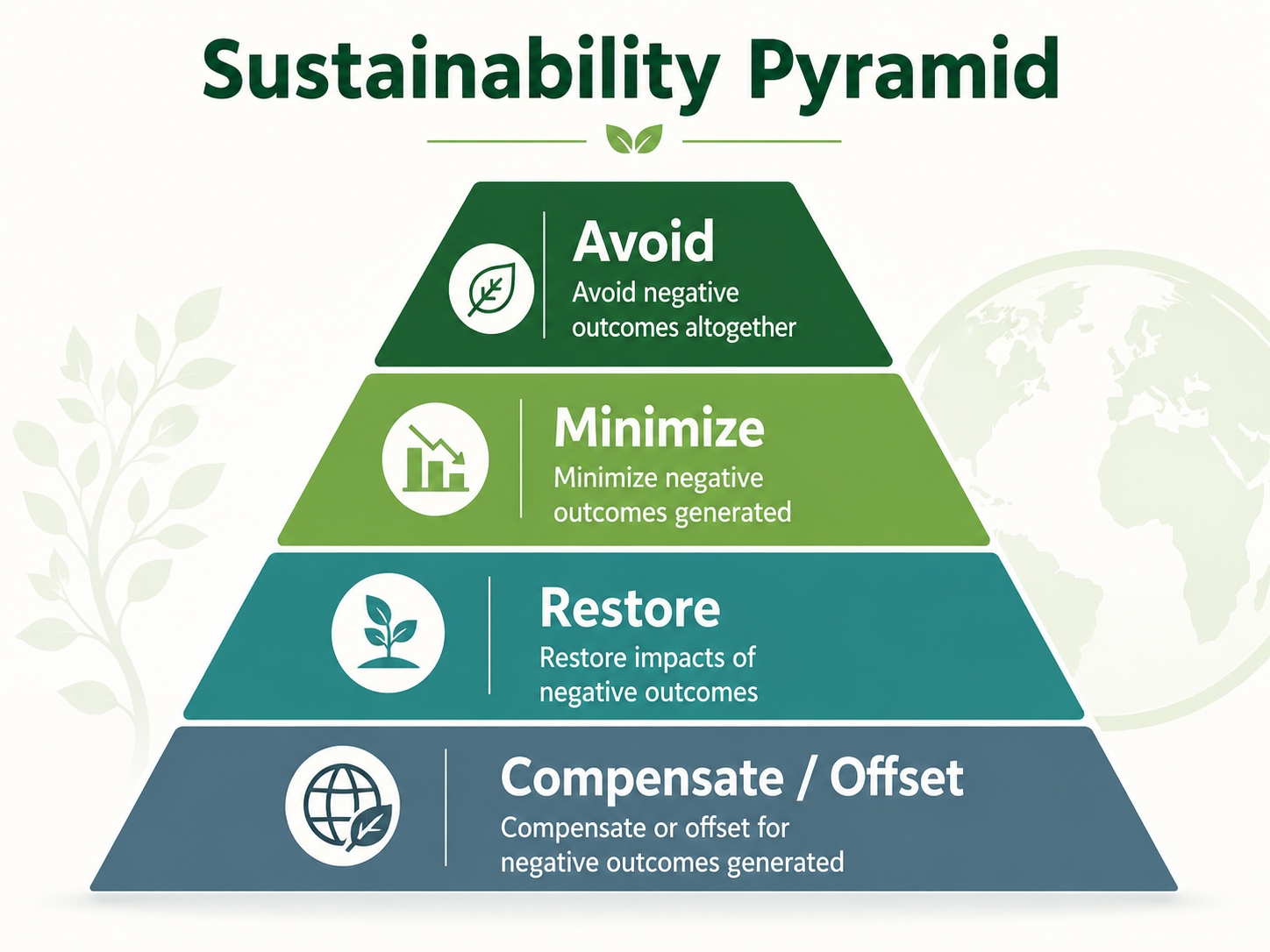
Question 153
A project manager is leading a hybrid project. The regulatory work is being managed predictively, while the customer-facing features are being delivered through short adaptive iterations.
Midway through the project, the team is updating the plan, reviewing performance data, managing risks, preparing for transition, and refining the backlog at the same time. A team member says, “I thought initiating, planning, executing, monitoring, and closing happen one after another. Why are we doing these activities together?”
What should the project manager explain?
Midway through the project, the team is updating the plan, reviewing performance data, managing risks, preparing for transition, and refining the backlog at the same time. A team member says, “I thought initiating, planning, executing, monitoring, and closing happen one after another. Why are we doing these activities together?”
What should the project manager explain?
Question 154
A project has an approved Budget at Completion (BAC) of $1,000,000. At the current reporting date, the project manager reviews the following performance data:
The sponsor asks whether the team can still finish within the original approved budget.
What is the To-Complete Performance Index (TCPI) required to complete the project within the original BAC?
The sponsor asks whether the team can still finish within the original approved budget.
What is the To-Complete Performance Index (TCPI) required to complete the project within the original BAC?
Exhibit
| Measure | Value |
|---|---|
| Earned Value (EV) | $600,000 |
| Actual Cost (AC) | $750,000 |
| Budget at Completion (BAC) | $1,000,000 |
Question 155
A checklist is useful as a reminder list, but the project manager should remember that it is [ Select ].
Question 156
A project manager discovers that a team member knowingly altered testing results to make a deliverable appear compliant. The team member explains that the defect is minor, the schedule is tight, and reporting the issue could damage the project manager’s reputation. The project manager has evidence that the test result was falsified.
What should the project manager do?
What should the project manager do?
Question 157
The project manager is reviewing the project life cycle and needs to determine the appropriate action at a phase gate. The current phase has met its exit criteria, deliverables have been verified, and the project remains aligned with organizational strategy.
Select the most appropriate phase gate decision:
Select the most appropriate phase gate decision:
Question 158
The schedule for completing the artificial intelligence software development work is very tight. To support the in-house team, the project manager has received approval to hire an auxiliary team. This team will work virtually from a different time zone.
The project manager is now defining the communication and collaboration requirements for the virtual team.
Which of the following tools is least useful for problem solving in a virtual team environment?
The project manager is now defining the communication and collaboration requirements for the virtual team.
Which of the following tools is least useful for problem solving in a virtual team environment?
Question 159
During quality audits, the QA team finds that the development process consistently produces minor defects that are later caught during testing. The project manager wants to address the root cause rather than simply increasing testing cycles.
Which quality approach BEST aligns with project management best practices?
Which quality approach BEST aligns with project management best practices?
Question 160
A project manager is leading a medical device development project. During execution, the quality team performs two different activities:
Which statement is correct?
Which statement is correct?
Exhibit
| Activity | Description |
|---|---|
| Activity 1 | Reviews whether the team is following approved development, testing, documentation, and compliance processes |
| Activity 2 | Inspects completed device components to confirm they meet technical specifications and acceptance criteria |
Question 161
A project manager is developing the schedule for a data center migration project. The network diagram shows that three technical activities can be performed in parallel. However, all three activities require the same senior network engineer, and only one senior network engineer is available. The sponsor wants the project completed as early as possible but does not approve hiring an external engineer.
What should the project manager do next?
What should the project manager do next?
Exhibit
Question 162
Review the exhibit.
What is the best interpretation?
What is the best interpretation?
Exhibit
| Item | Current Status |
|---|---|
| Product delivered | Yes |
| Schedule baseline | Met |
| Budget baseline | Met |
| User adoption | Low |
| Expected cost reduction | Not achieved |
| Customer satisfaction | No improvement |
| Sponsor report | “Project completed successfully” |
Question 163
A project manager is assigned to a project to develop a new customer self-service portal. The organization’s standard methodology requires a fully predictive life cycle, detailed requirements sign-off before development, monthly status reports, and formal approval for every scope change. After reviewing the project context, the project manager finds the following:
What should the project manager tailor?
What should the project manager tailor?
Exhibit
| Diagnostic Area | Project Situation |
|---|---|
| Requirements | Core features are known, but user experience details will evolve through feedback |
| Compliance | Customer data privacy controls are mandatory |
| Stakeholders | Business users want demonstrations every two weeks |
| Team | Experienced with agile delivery |
| Sponsor expectation | Early usable releases are preferred |
| Governance | Budget and release approvals must remain formal |
Question 164
A project has a Budget at Completion (BAC) of $900,000. At the current reporting date, the project manager reviews the following data:
The project is over budget because a supplier delivered defective components, causing one-time rework. The supplier has corrected the issue, and the project manager believes the remaining work can be completed according to the original cost plan.
Which Estimate at Completion (EAC) formula should the project manager use?
The project is over budget because a supplier delivered defective components, causing one-time rework. The supplier has corrected the issue, and the project manager believes the remaining work can be completed according to the original cost plan.
Which Estimate at Completion (EAC) formula should the project manager use?
Exhibit
| Measure | Value |
|---|---|
| Planned Value (PV) | $450,000 |
| Earned Value (EV) | $400,000 |
| Actual Cost (AC) | $520,000 |
Question 165
A project manager is monitoring project performance using Earned Value Management. The project has been performing close to the baseline during the first three reporting periods. However, in the latest reporting period, both schedule and cost performance fall below acceptable thresholds.
The organization’s control limits are:
CPI below 0.90 = cost performance requires corrective action
SPI below 0.90 = schedule performance requires corrective action
Click on the point where both CPI and SPI are below the acceptable threshold and corrective action is required.
The organization’s control limits are:
CPI below 0.90 = cost performance requires corrective action
SPI below 0.90 = schedule performance requires corrective action
Click on the point where both CPI and SPI are below the acceptable threshold and corrective action is required.
Exhibit
| Reporting Period | CPI | SPI |
|---|---|---|
| Month 1 | 1.02 | 0.98 |
| Month 2 | 0.96 | 0.95 |
| Month 3 | 0.91 | 0.93 |
| Month 4 | 0.84 | 0.86 |
Exhibit
Question 166
A project manager moves from one company to another. The new employer is starting a similar project and asks the project manager to share templates, risk registers, and cost models created at the previous company. The project manager still has copies and believes they would help the new team avoid mistakes.
What should the project manager do?
What should the project manager do?
Question 167
What should the project manager conclude?
Exhibit
| Situation | Governance Risk |
|---|---|
| Too many approvals for a low-risk internal tool | Delay and wasted effort |
| No clear decision authority for a strategic project | Conflicting decisions |
| No escalation path for vendor delays | Slow response to issues |
| No benefit measures | Output delivered without proving value |
Question 168
A new engineering project will require a large number of physical resources, such as equipment, materials, tools, and storage space. Because these resources are critical to project success, the project manager is working closely with several team members to plan how the resources will be obtained, transported, stored, and made available when needed.
Which statement is true about physical resource planning?
Which statement is true about physical resource planning?
Question 169
A company is developing a parking ticket booking app for stadiums that will be used during the 2024 Olympics. Since the event date is fixed, the team is under pressure to meet the schedule.
What could happen if the team rushes or skips planned quality inspections to stay on schedule?
What could happen if the team rushes or skips planned quality inspections to stay on schedule?
Question 170
A project manager is leading a regulatory reporting project. The team decides to use short iterations for report design because stakeholder feedback is needed frequently. However, the project will still require formal sign-off for compliance requirements, documented traceability, and approval before production release. Some stakeholders are confused because they expected the organization’s normal predictive approach, while others think the project is now fully agile.
What should the project manager do?
What should the project manager do?
Question 171
A project manager is managing a product launch project. The marketing manager wants two extra weeks to prepare a stronger campaign, while the operations manager wants to launch on the original date because warehouse capacity is already reserved. Both stakeholders have valid concerns, but the sponsor says the launch date can move by only one week.
What should the project manager do?
What should the project manager do?
Question 172
Daniel is a software developer with 3 years of experience. He has recently joined a new digital transformation project that requires close coordination, frequent technical decisions, and continuous collaboration with other team members. Another developer, Alex, who has 5 years of experience, will also work on the same project.
As the project manager, you want both developers to succeed, feel motivated, and contribute their best work. You also want to avoid micromanagement while ensuring that the team remains aligned with the project goals and expected outcomes.
What should you do?
As the project manager, you want both developers to succeed, feel motivated, and contribute their best work. You also want to avoid micromanagement while ensuring that the team remains aligned with the project goals and expected outcomes.
What should you do?
Question 173
A project manager is assigned to a strategic digital transformation project. During early planning, the sponsor describes the project as a cost-reduction initiative, the operations team sees it as a process-improvement effort, the IT team treats it as a system-replacement project, and end users believe it should improve service speed and usability. As a result, meetings are becoming confusing, priorities are unclear, and stakeholders are interpreting success differently.
What should the project manager do first to develop a common vision?
What should the project manager do first to develop a common vision?
Question 174
A project manager has been appointed to design and develop a strategy for a government organization. At this early stage, the project manager has limited detailed information for preparing accurate estimates. However, several other government organizations have already implemented similar strategies successfully.
Which estimating technique is most appropriate in this situation?
Which estimating technique is most appropriate in this situation?
Question 175
During a project retrospective, the testing team reports frequent bottlenecks in receiving builds from the development team. These delays have caused several days of schedule slippage and delayed one project milestone. The project manager wants to understand the current workflow and identify where delays are occurring.
Which tool is most appropriate for identifying bottlenecks in the process?
Which tool is most appropriate for identifying bottlenecks in the process?
Question 176
An agile project team is building a website for a client. The client tells the product owner that the company now wants to release the website one month earlier to take advantage of a business opportunity.
What should the project manager have the team do first?
What should the project manager have the team do first?
Question 177
A company is expanding product manufacturing into a new country. The start-of-operations date has already been set and broadly communicated. However, the project team is unsure whether there is enough time to implement all planned product features before that date.
What should the project manager do to help ensure the critical features are ready by the committed date?
What should the project manager do to help ensure the critical features are ready by the committed date?
Question 178
A project manager joins an existing project team after the previous manager left. During the first meetings, the new project manager notices that team members have different opinions about technical decisions, do not respect each other’s ideas, and the team environment is becoming counterproductive.
After the new project manager provides leadership and guidance, the team begins communicating more effectively and developing shared processes and procedures for working together.
Which stage of team development is the team in now?
After the new project manager provides leadership and guidance, the team begins communicating more effectively and developing shared processes and procedures for working together.
Which stage of team development is the team in now?
Question 179
Joseph is managing a project from the Paris office in France. His project team is developing a new cutting machine for a two-wheeler manufacturing company. The team is currently gathering and clarifying project requirements.
Which stakeholder group is most important for providing clear direction on the requirements?
Which stakeholder group is most important for providing clear direction on the requirements?
Question 180
An artificial intelligence project has been running for six months. The project team includes technical team members and business executives located in different countries and time zones. The project manager is trying to understand cultural behaviors, such as why some team members stand when a senior person enters a meeting or avoid direct eye contact when speaking with senior leaders.
Which skill is the project manager using?
Which skill is the project manager using?
Finish Exam and Review Answers
Click the button below to calculate your score and show the answers and explanations for all questions.